
Where Can You Find Reliable Local Restaurants in Wulingyuan?
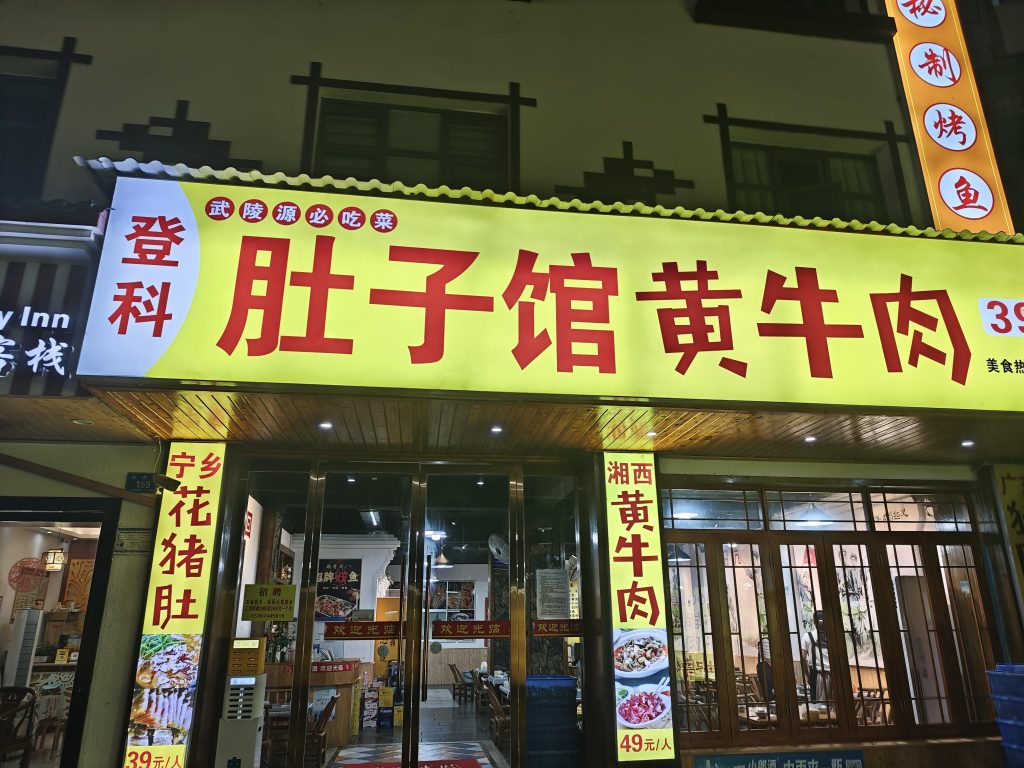
Wulingyuan locals do not eat on the street directly opposite the park gate. Walk two or three streets back to the residential lanes off Jun Di Road, Wei Yang Road and Bao Feng Road, and you will find the places with worn tables, a wok at the doorway and the owner doing the cooking. Chinese travellers call them cangying guanzi, or “fly restaurants” — rough little shops that cook for regulars rather than tour groups. They cost about half as much as the restaurants at the entrance.
1. Which street is overpriced, and which streets are cheaper?
Most visitors to Wulingyuan stay around Jun Di Subdistrict, where the Wujiayu ticket gate — the “Mark Gate” — sits. The street right outside the gate is set up for tourists: staff wave you in, signs say “authentic Tujia cuisine”, and the menus are full of colour photos. One traveller ordered a 128 yuan rock-ear chicken stew there and found dry meat, very little rock ear and a broth that tasted of MSG. Walk one street towards the residential area and the same dish costs 30 to 50 percent less.
2. How can you tell whether locals actually eat there?
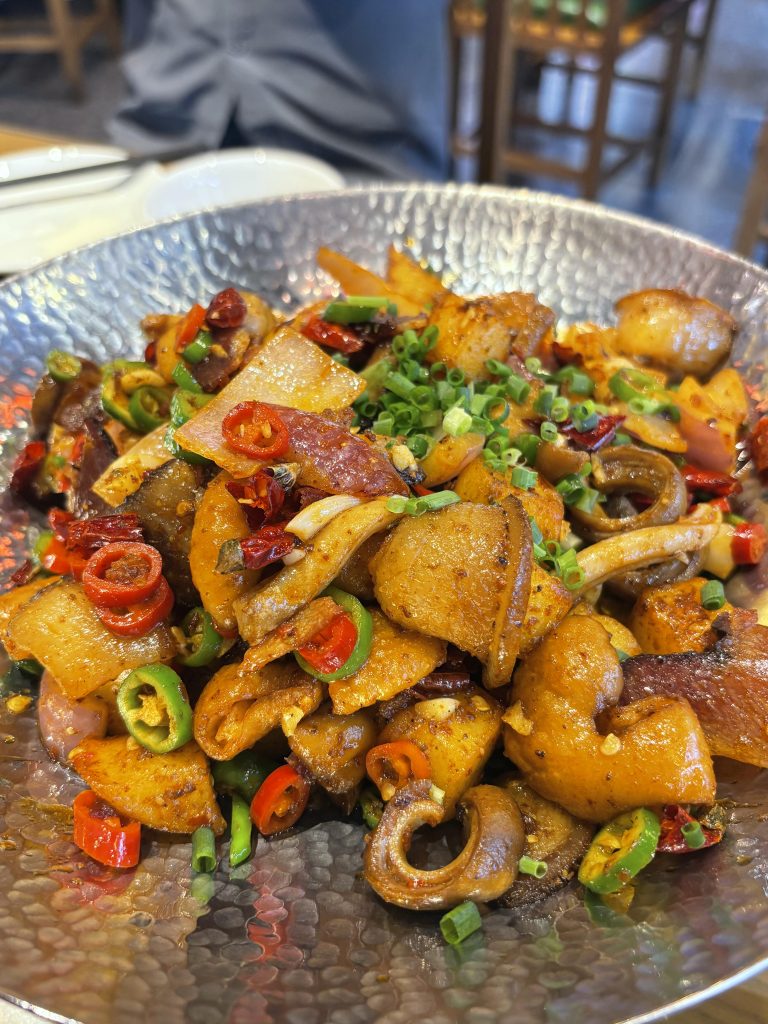
Look for a wok at the front. If you can see flames, smoke drifting into the street and the cook working at the door, you are in the right kind of place. A hidden kitchen, spotless glass doors and staff in matching uniforms usually mean a tourist restaurant.
Look at the menu. A thick photo book with English translations is a sign to check prices before you sit down. A single A4 sheet, handwritten or printed in black and white, with prices crossed out in marker, is a better sign.
Look at the stools. Plastic stools, round metal tables and a roll of toilet paper on the wall mean the regulars are locals. Scooters parked outside and people waiting with takeaway boxes tell you the same thing.
3. Which restaurants are worth walking into?
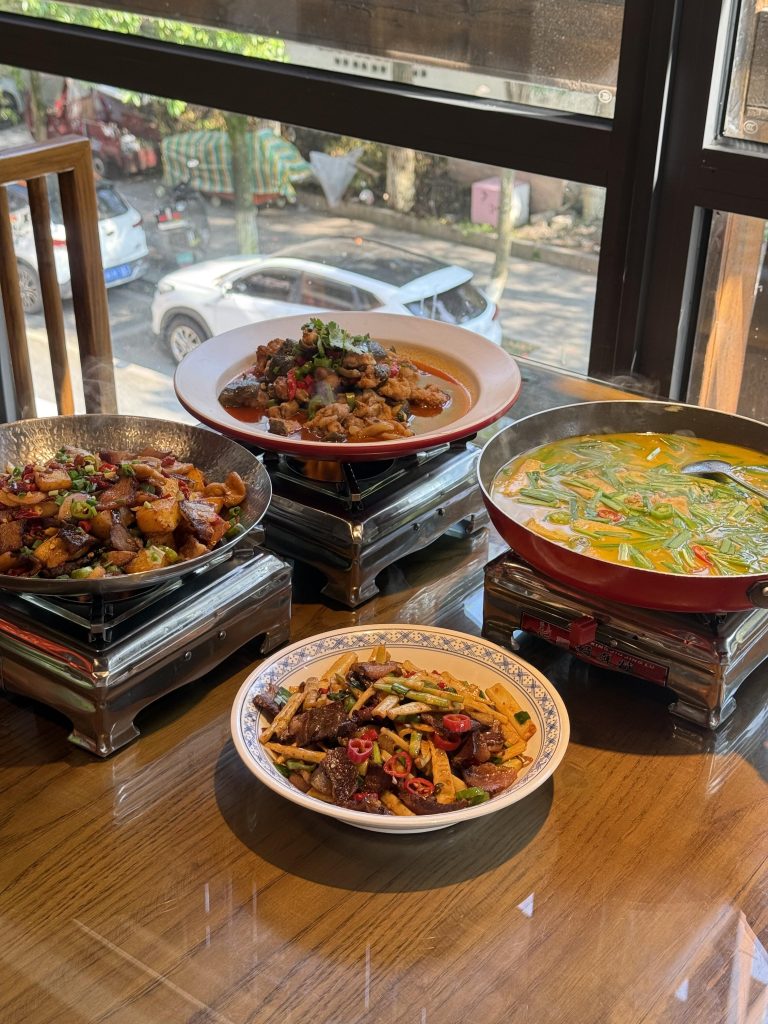
All the places below are in Wulingyuan, with addresses and prices you can check. The prices are from 2026. Small restaurants change hands often, so search the name on a map before you go and confirm it is still open.
Hao Pin Wei Tu Cai Guan is on Jun Di Road, inside the Wu Jiayu residential compound, about 44 yuan per person. Tables sit on the ground floor of an apartment block and spill into the hallway, making it the closest thing to a fly restaurant on this list. A visitor wrote in March 2026 that it is an easy walk from the Mark Gate and the owner recommends dishes. The sign is small; once your map reaches the compound, you still have to walk a few dozen metres inside.
Lao Shi Tujia Tu Yun San Xia Guo is on Bao Feng Road, opposite the Tianyu Hotel, about 48 yuan per person. Its environment score is 3.3 and service 3.7 — bad marks for a tourist restaurant, but here they mean the owner spends nothing on decoration. Sanxiaguo comes as a soup pot or a dry pot. Rock-ear chicken stew and chilli fried pork are the dishes people order, and most diners are local families.
Hu Shifu San Xia Guo on Jun Di Road costs 50 to 60 yuan per person; a small pot at 68 yuan feeds two. It is an old brand and no longer hidden, but prices have stayed put. The smoked pork, springy pork tripe and properly cleaned intestines are worth ordering, with dried radish and garlic shoots on the side. Ask for mild spice — local chillies have a slow, strong burn.
Mao Shi Xiao Guan is on Wei Yang Road, next to the Qinghe Boutique Hotel, about 53 yuan per person. It cooks everyday Hunan home food; wild mushroom braised pork and the house barbecued fish are the signatures. The owner will ask whether you can handle the heat and can remake a dish without chilli. It now appears on review platforms, so you will see more tourists here than in the places above, but prices have not followed.
Hong Ji Tu Cai Guan sits inside Hong Yuan Market on Tian Zi Road, about 69 yuan per person. It is a market kitchen serving stir-fries, skewers and hot pots, open until 1:30 a.m. If you come off the mountain late and want something hot, this is the last place still cooking.
There is also Chen Meizi Sangzhi Tripe and Beef Restaurant at 238 Bao Feng Road, about 49 yuan per person. Sangzhi is a county under Zhangjiajie, and Sangzhi-style tripe and beef is a local way of cooking the two together in one pot. Review scores are low and local customers are plenty.
4. Is Xibu Street still worth a visit?
Xibu Street has largely shut down. Do not make a special trip based on older guides. Opened in 2012, the Tujia-themed pedestrian street along the Suoxi River used to be the busiest part of Wulingyuan at night. In 2025 a visitor arrived to find the street dark; a road worker told him it had closed long ago. Guides written in 2026 give the same warning. The operator ran into financial trouble in 2024, part of the shops were auctioned, and reorganisation began in early 2026. Booking sites still show “open 24 hours” — that data was never updated.
A few restaurants near the entrance are still open. Suo Xi Shan Zhai’s Xibu Street branch is at the Bao Feng Bridge end of Tian Zi Road, beside the west gate, and still shows as open on maps. The street inside is closed, but the shops around it may not be. Ask your hotel reception to call ahead, or simply go to the Mark Gate branch.
For dinner and late-night food, go to Jun Di Road snack street. It is a short walk from the gate. After dark, stalls line up with sanxiaguo, smoked pork skewers, stinky tofu, Tujia she rice, mugwort cakes and rice tofu. Further out, the night market on Bai Lu Road in Jun Di runs from 6:30 p.m. to 2 a.m.
5. How do you order if you do not speak Chinese?
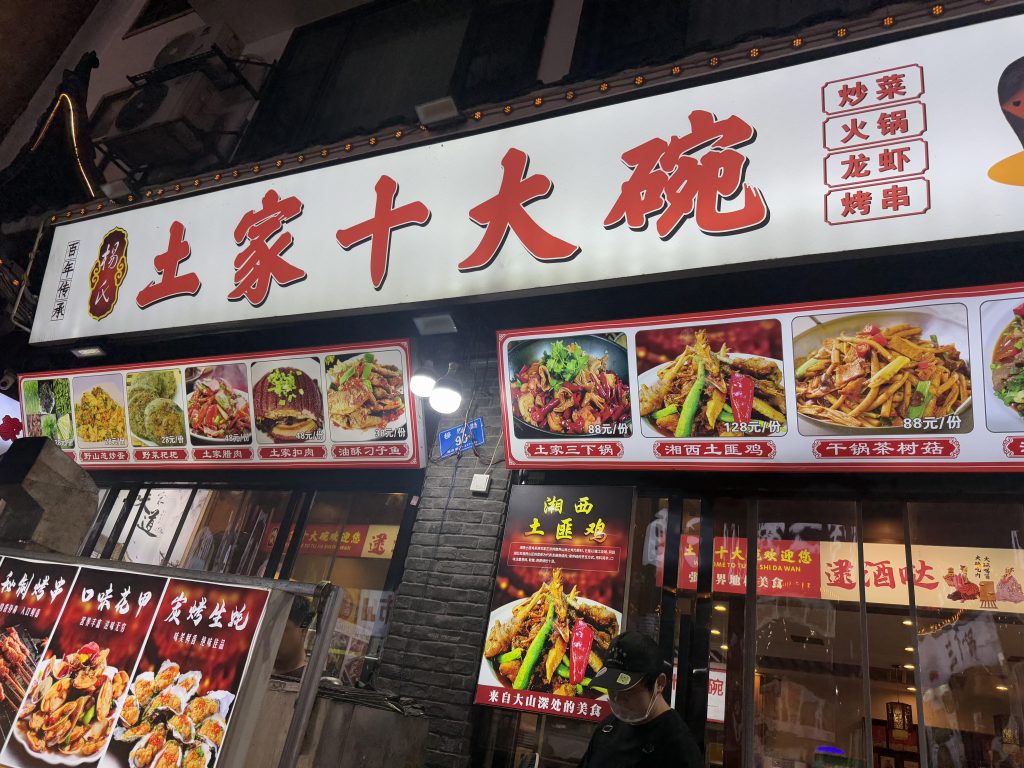
Pinyin is for you to say. Chinese characters are for the owner to read. Every small restaurant knows the name of its own dishes. Save the Chinese names below as a screenshot on your phone and point at them — that works almost every time.
You do not need to wait to be seated. Take any free table; the tissues and the teapot on it are for you. The owner will bring a menu or point at the sheet on the wall. If there are no pictures, point at a name you recognise and ask the price. Most owners will type the number into a calculator for you.
This — zhè ge. Point at the menu, or at the plate on the next table.
How much — duō shao qián.
Two people — liǎng ge rén.
Rice — mǐ fàn.
No chilli — bú yào là.
Do not add chilli — bú fàng là jiāo. More precise than “no chilli”.
Less chilli — shǎo fàng là.
No coriander — bú yào xiāng cài.
Takeaway — dǎ bāo. For food you cannot finish.
The bill — jié zhàng. Also mǎi dān.
Dish names to read out: sanxiaguo, sān xià guō; rock-ear chicken stew, yán ěr dùn tǔ jī; smoked pork with fern cake, là ròu chǎo jué bā; hezha, hé zhā; mugwort cakes, hāo zi bā bā; rice tofu, mǐ dòu fu; rice noodles, mǐ fěn; stir-fried greens, qīng chǎo shí shū.
Numbers: yī, èr, sān, sì, wǔ, liù, qī, bā, jiǔ, shí. Dishes are counted with “ge”: yí ge, liǎng ge, sān ge.
Your tones do not have to be perfect. Say sanxiaguo well or say it badly — the owner will know, because only one dish in this area has that sound. The phrase that causes trouble is bú yào là. Say it quickly and it sounds like yào là, “add chilli”, the exact opposite. Stretch the “bu”, or wave your hand, say bú yào and point at the chilli.
6. What if you are travelling with children or older people, and how do you pay?
If you do not want to work this hard, go to Suo Xi Shan Zhai. The Mark Gate branch is at the junction of Jun Di Road and Tuofeng Road. It has an English menu, staff who explain the dishes, and average spending of around 70 yuan per person. It is not a fly restaurant and costs more than the places above, but it saves effort.
Carry cash. Most of these small restaurants cannot take a foreign credit card, and some payment codes are linked only to Chinese accounts. Bring a few hundred yuan in cash. Ask before you order whether cards are accepted; if not, pay cash and ask for a receipt showing the restaurant name and amount.