
How to Avoid Overpriced Restaurants in Zhangjiajie?
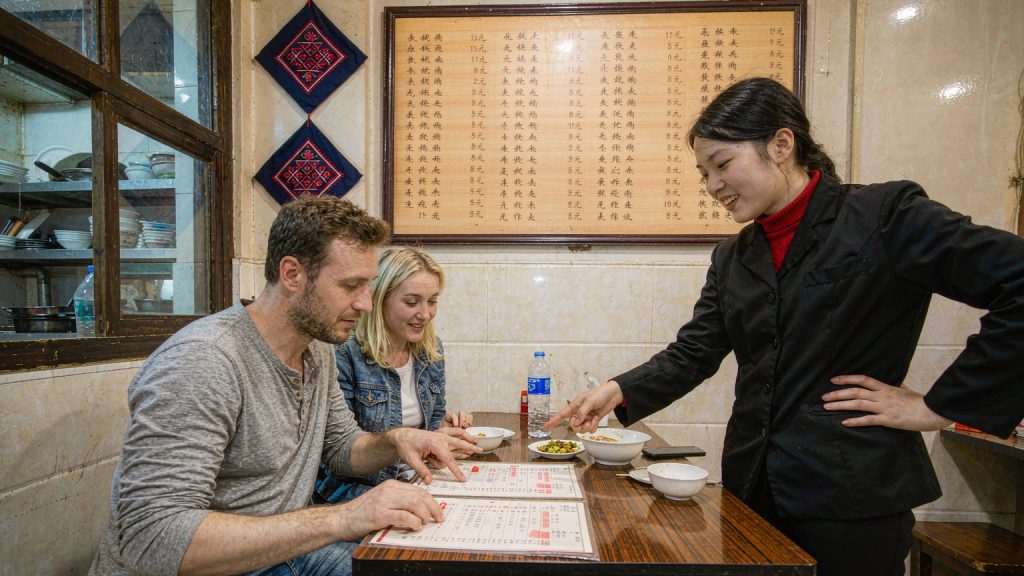
The best way to avoid overpriced restaurants in Zhangjiajie is to check the printed menu and posted prices before you sit down, refuse a last-minute recommendation from a driver or stranger, and confirm the unit price, the weight and any tea or service charge before you order. Zhangjiajie has plenty of decent restaurants. The ones that cause trouble are near park gates and stations, the places a driver takes you to, and any restaurant with no prices on the menu, no visible weighing, or a total revealed only at the bill. A travel guide gives a rough range of 45 to 80 yuan per person for a sit-down meal, 30 to 50 yuan for a packed meal inside the park, and 5 to 8 yuan for bottled water in the park versus 2 to 3 yuan in a town supermarket; these are reference prices, not official ones.
1、Which restaurants are most likely to overcharge tourists?
The first type is a restaurant you are talked into visiting at the last minute by a driver or a stranger. In February 2025, Zhangjiajie’s Yongding District reported a case in which a taxi driver and a restaurant worked together to overcharge visitors: acting on the driver’s recommendation, the visitors were charged 844 yuan for two dishes, including fish billed at 258 yuan per jin for 2.6 jin; the restaurant was ordered to suspend business and a case was opened. The point is not that all taxi drivers are untrustworthy. It is that if someone changes your destination at the last minute, insists the place is “where locals eat,” and will not let you see a menu first, you should leave.
The second type is the restaurant directly opposite a park entrance. The Wulingyuan District Market Supervision Bureau advises diners to check menu prices, watch for “two menus” with different prices, and see whether tea and service charges are included. Travel guides also warn that prices right at park gates are higher. A clearly posted price that you accept is simply expensive; a hidden price, an inflated weight, or a bill that changes at checkout is overcharging.
The third type is a restaurant with only picture menus and no local customers. This is a rule of thumb from travel guides, not an official test. A safer approach is to walk one street toward the residential area from the Wulingyuan “Marking Gate” or the main street, or to look for places locals eat near Zhangjiajie City railway station and the pedestrian streets.
2、What should you check before you sit down?
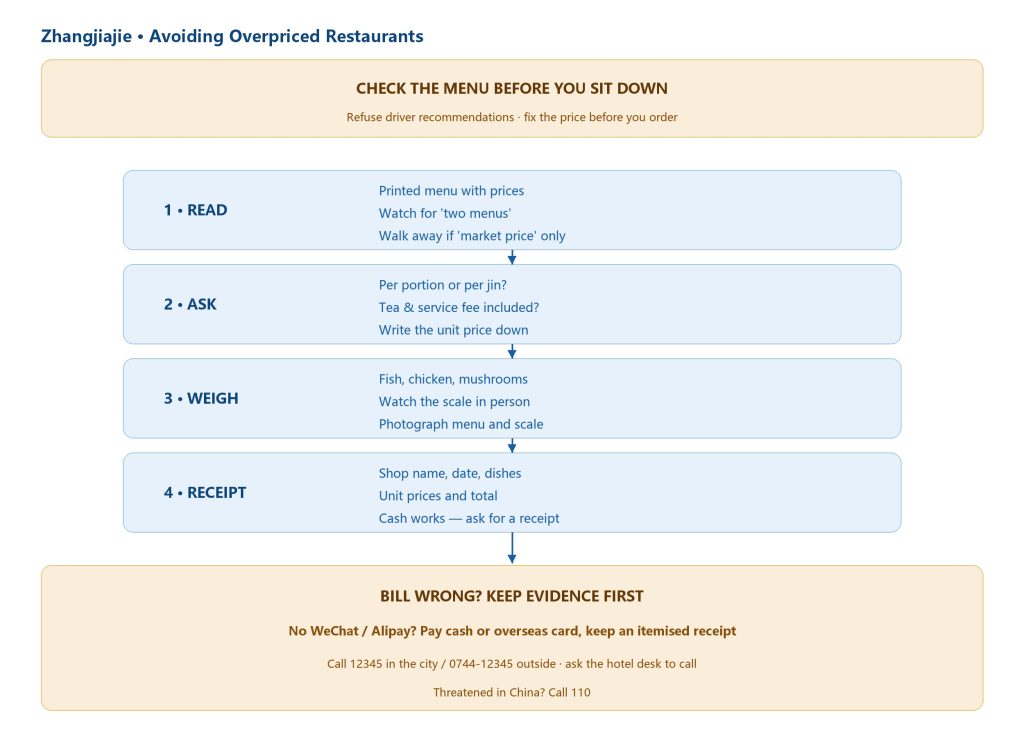
Sitting down first puts you at a disadvantage; check the menu before you decide. Look for a wall menu or a printed menu with dish names and prices. Ask whether a dish is priced “per portion or per jin,” how much it costs per jin, and whether tea and service charges are included. If the waiter only says “market price” but will not write it down, walk away.
Confirm the weight of any dish sold by weight. For fish, free-range chicken and wild mushrooms, ask for the net weight, the unit price and the total, watch the weighing in person, and photograph the menu and the scale. Fixing the price before you order is more useful than arguing afterwards.
Do not confuse “expensive” with “overcharging.” Transport and labour cost more inside the park, so a clearly priced packed meal or drink is often dearer. You can choose not to buy, but if the price is written down, the weight is correct, and nothing is forced on you, it is not the same problem.
3、How do you make the price clear when you order?
If you do not read Chinese, type your questions into your phone and show the waiter. You can write: “Please write down the unit price and the total.” “Is this dish priced per portion or per jin?” “Are tea and service charges included?” “Bring the menu first, not the food.” One question at a time is easier to answer.
Ask about portion size for local dishes too. “Three pot stew” is usually a shared pot; a travel guide gives a rough 60 to 80 yuan for two people in Wulingyuan. Tujia cured pork, sour fish soup and chicken stew with rock ear fungus vary widely, so ask whether they are sold by weight before you order. Only order wild mushrooms in a proper restaurant, and do not buy unidentified “mountain produce” from a trailside stall.
Keep a record of payment, but do not assume every foreign visitor has WeChat or Alipay. If you already have the international versions of Alipay or WeChat installed and linked to an overseas bank card, an electronic payment record works. If you do not have these apps, pay in cash or with a usable overseas bank card and ask for a receipt on the spot showing the shop name, date, dishes, unit prices and total. Small shops may not accept overseas cards, so ask before you go in. A receipt with no shop name, no amount and no itemised dishes is of little use in a complaint.
4、What should you do if the bill is wrong?
Keep your evidence first; do not grab the bill. Photograph the menu, the bill, your payment record, the dishes and the weighing, and ask the staff to explain each line. If you suspect an inflated price or short weight, first ask them to settle at the posted price; if that fails, complain.
Dial the number for where you are. If you are in Zhangjiajie with a Chinese SIM card or international roaming, dial 12345 within the city and 0744-12345 outside the city; for consumer complaints, dial 0744-12315. The 12345 and 12315 short numbers have only published domestic dialling instructions, and overseas connection is not guaranteed, so do not copy the short numbers from abroad. Without WeChat, Alipay or a Chinese phone number, you can ask your hotel front desk or a visitor service centre to call for you, use the mayor’s mailbox website, or complain at an on-site service desk; if you already have the apps, the 12315 mini-program is another option. If you are threatened or your freedom is restricted while in China, call 110.
If the menu has no prices and the total appears only at checkout, the safest move is to cut your losses immediately. If the food has not arrived, refuse the order and leave. If it is already on the table, photograph it to confirm the price, then ask to settle at the posted price. Haggling saves little; evidence and a payment record are what make a refund possible.
资料来源:
1、Wulingyuan District Market Supervision Bureau: holiday consumption tips — check menu prices, watch for “two menus,” look for tea and service charges; 12345 and 12315 complaint channels
2、Zhangjiajie Market Supervision Bureau: complaint and reporting channels — phone channels 0744-12315 and 0744-12345; national 12315 platform mini-program; mayor’s mailbox
3、Zhangjiajie municipal government portal: notice on how to dial 12345 — dial 12345 within the city, 0744-12345 elsewhere
4、China Mobile: how to call China from overseas — when roaming, dial “+” and 86 for China; drop the leading 0 in the area code; special short numbers are not guaranteed to connect
5、Dongjing Stories: two dishes for 844 yuan at a Zhangjiajie restaurant — how visitors can protect their rights — February 2025 case; the restaurant was ordered to suspend business and a case was opened; keep the menu, bill, payment record and photos
6、Eating in Zhangjiajie: A pragmatic guide to local food and prices — sit-down prices, mark-ups at park gates, bottled-water price differences, payment and language tips
7、What to Eat in Zhangjiajie — three-pot stew price reference, packed meals and bottled water inside the park, avoiding picture-menu-only restaurants
8、Zhangjiajie Food Guide: Where to Eat Along Your Route — where to eat in Wulingyuan, the city and the park; reference prices