
Best Light Hours for Photography in Zhangjiajie National Forest Park
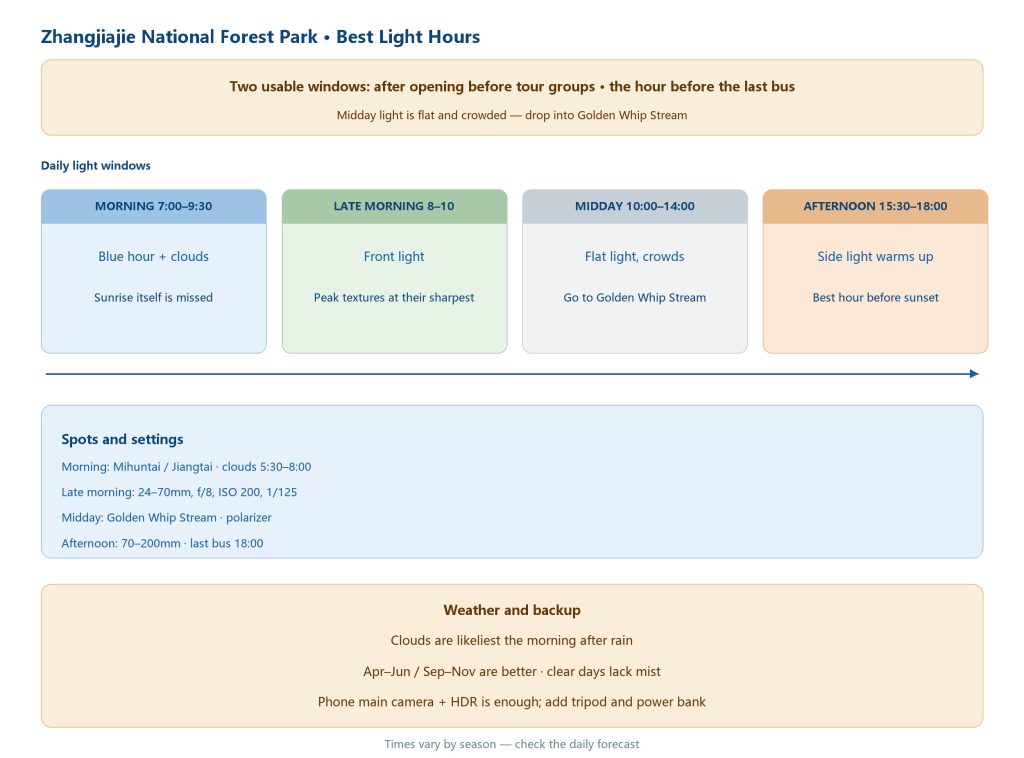
There are only two usable light windows in Zhangjiajie National Forest Park: after the gates open and before tour groups arrive, and the hour before the last environmental bus leaves. The middle of the day brings flatter light and bigger crowds, so the Golden Whip Stream is a better place to be. The park here means the Wulingyuan core scenic area. Tianmen Mountain and the Grand Canyon need separate tickets and do not follow the same schedule.
Sunrise and sunset times change a lot with the season. On 29 November 2026, Moji Weather listed sunrise in Zhangjiajie city at 07:13 and sunset at 17:40. By early December, sunrise moves to around 07:20 while sunset stays near 17:40. The viewing platforms are on the mountain, so the light you actually get depends on terrain and cloud cover. Checking the daily forecast before you go is the safer approach.
When should you arrive for sunrise in the forest park?
To catch the blue hour and cloud sea around sunrise, arriving at the viewpoint 30 to 45 minutes early is usually enough. Common Chinese guides put summer sunrise at about 5:30 to 6:00 and winter sunrise at about 7:00. The sky starts to turn blue half an hour before sunrise, and the peak forest looks its best when warm light hits the clouds. The morning after rain is usually the best chance for a cloud sea.
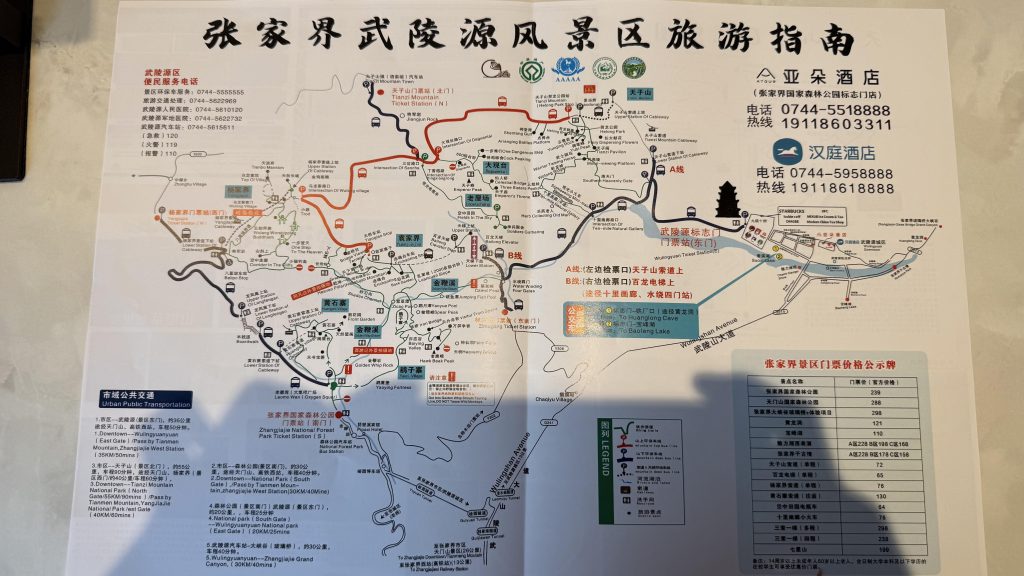
The forest park opens at about 7:00 and the environmental buses stop at about 18:00. Mid-October sunrise is around 6:50, which means the sun is up before the buses start running. An official notice states that overnight stays, camping and commercial lodging are not allowed inside the core scenic area, so the old advice to stay on the mountain and wait for sunrise no longer works. What you can realistically do is wait until winter, when sunrise moves past 7:13, and enter with the first batch to shoot the light after sunrise. The moment the sun actually breaks out is basically impossible to catch inside the forest park.
Tickets now use timed, gate-specific real-name reservations. An official notice also says travellers with overseas phone numbers or no phone number can use the manual service window, and asking your hotel front desk to book ahead is another option. Foreign visitors should bring the passport used for booking, and the name must match.
What does the light suit in the morning and at midday?
From 8:00 to 10:00 in the morning the light is usually front light, and the textures of the peak forest are at their clearest. Yuanjiajie and Tianzi Mountain both work well in this window, and the rock face of Qiankun Pillar shows more detail in front light. With cloud around, the floating effect is stronger. A camera can start at an equivalent 24 to 70mm, f/8, ISO 200 and 1/125 sec. On a phone, the main camera and HDR are enough; digital zoom loses detail.
After 10:00 tour groups start arriving, the main viewing platforms get crowded and the light becomes flatter. This is a better time to drop into the Golden Whip Stream or the Ten-Mile Gallery. The tree canopy breaks the sunlight into patches, and the stream and boardwalk become easier subjects. A polarizer cuts reflection from the water. If you want to use the hard midday light on the mountain, try black and white; the strong contrast can work well.
Which part of the afternoon is worth waiting for?
From 2:00 to 4:00 pm the light is side light, and the peaks show their strongest sense of depth. The stone walls at Tianbo Mansion and One Step to Heaven in Yangjiajie show their texture best in this window. Tianzi Mountain warms up after about 15:30, and an equivalent 70 to 200mm lens compresses the layers of Yubi Peak.
The hour before sunset is the golden hour, when the peaks turn warm and gold. After the sun goes down, it is worth keeping the camera out: pink and purple cloud against dark peak silhouettes is a different kind of image. The environmental buses stop around 18:00, and staff clear the trails after the last bus. In mid-October sunset is around 18:20, later than the last bus, so the usable evening window on the mountain is usually only the hour before that final departure. Confirm the exact last-bus time at the station on the day.
What weather gives you the best cloud sea?
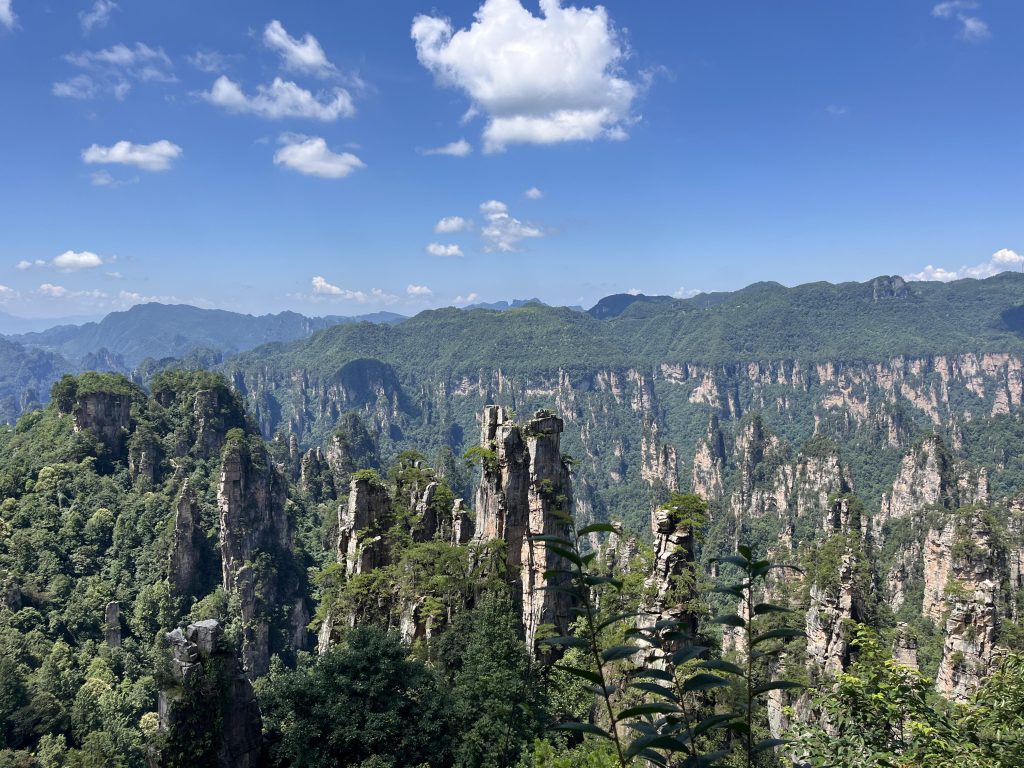
The morning after rain offers the highest chance of a cloud sea. Clouds usually sit in the valleys from about 5:30 to 8:00 and begin to lift as the sun rises. Good viewpoints include Jiangtai Pavilion, the Sky Garden, Daguan Platform and Mihuntai, all high enough and open enough to show layers. For moving cloud, try f/8 to f/11 and ISO 100 with the camera on a tripod for a long exposure.
Overcast and misty days are not wasted either. Without hard shadows, the peaks take on an ink-wash quality, although low visibility means watching your step. Clear days are transparent but short on mist, so the floating feeling becomes weaker. A photography trip is best planned over four days, which gives you a better chance of two or three usable days. April to June and September to November bring better odds of both cloud and stable weather.
Is a phone good enough for sunrise and sunset?
The main camera on a phone with HDR is already good enough for most of these scenes. The real extras are a small tripod and a power bank. The mountain is cooler than the city, and phones lose battery faster around sunrise and after sunset. Keeping the phone close to your body for a while before shooting usually helps.