
Do You Need to Bargain When Buying Souvenirs in Zhangjiajie?
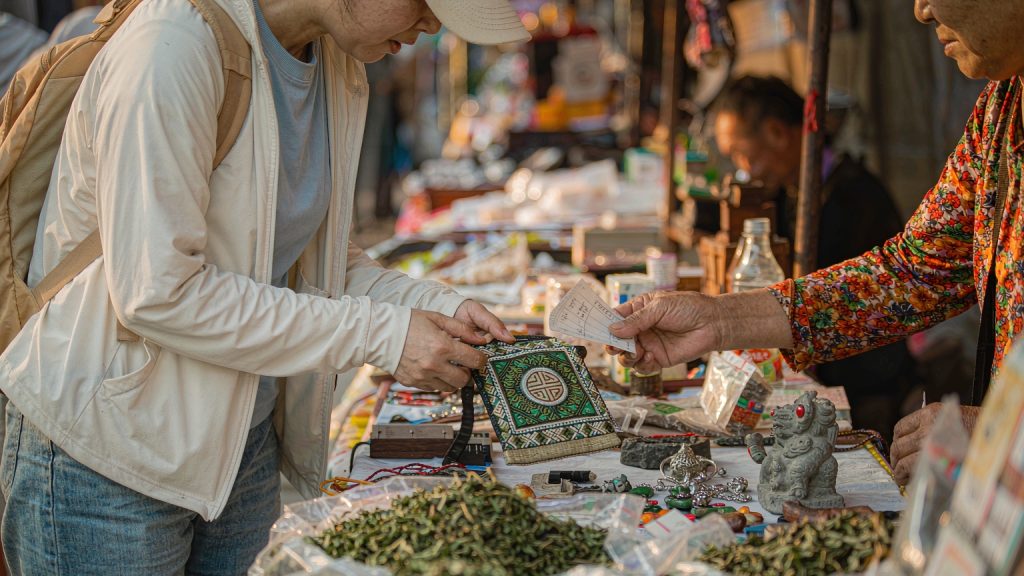
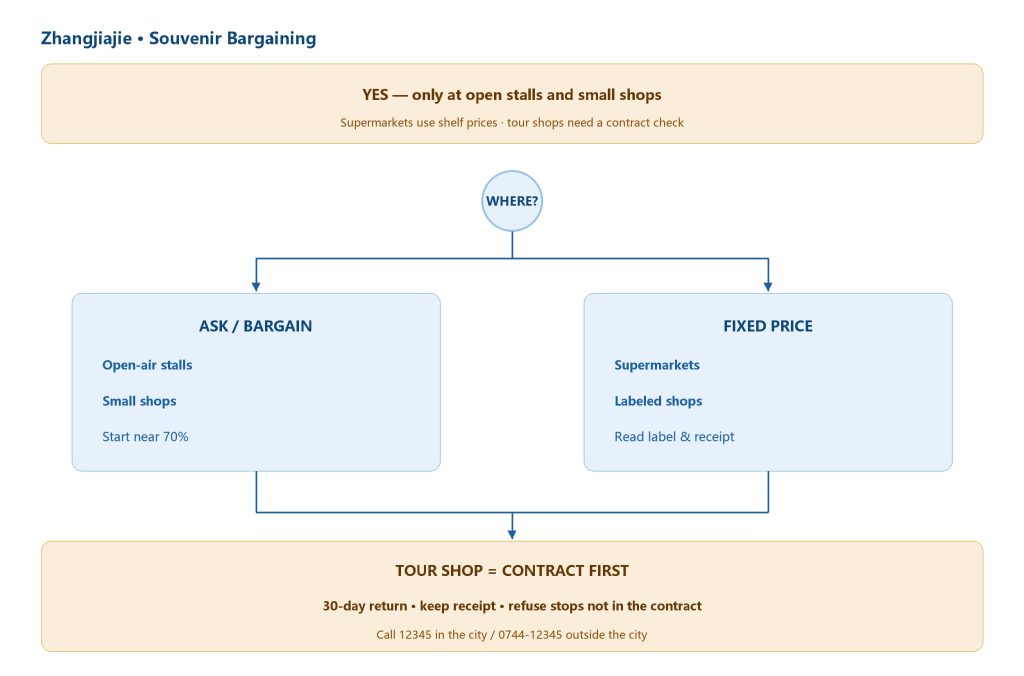
Yes, but only in certain places. At open-air stalls and small independent shops, polite bargaining is normal; in supermarkets and clearly priced shops, you pay the shelf price. If a tour takes you to a shopping stop, bargaining is not the issue — check the contract first and refuse any shopping stop not written into it. Ask about net weight, receipt and returns before you bargain. The real risk is not saving a few yuan, but buying herbs, jade, cinnabar or “wild” products you cannot judge.
1、Where can you bargain in Zhangjiajie, and where should you not bargain?
The tourist stalls on Tianzijie Street and Xibu Street in Wulingyuan, and around People’s Square Pedestrian Street in Yongding, usually expect questions about price. Similar brocade bags or sand paintings may have different quotes. Compare two stalls, then ask “Can it be cheaper?” or “What is the price for two?” At supermarkets such as Meini and Genli, prices are on the shelf. Check the ingredient list, net weight and receipt instead of bargaining.
Stalls inside scenic areas are usually more expensive; do not treat that price as normal. For packaged food, tea and small handicrafts, buy in Wulingyuan town or Zhangjiajie city before entering the park. You can read the label and go back to the shop if there is a problem. Do not buy expensive items on impulse inside a scenic area.
2、How do you bargain naturally in Zhangjiajie?
Ask for the total price and the unit first, then ask whether the price can go down. For tea, ask the price per 100 g. For powders, ask about net weight and ingredients. For brocade, ask whether it is machine-woven, handwoven, or only partly handwoven. Do not ask only “Is it cheap?” The seller will simply say “It is already cheap.”
You can start at about 70% of the asking price, but do not push handwoven work down to machine-made prices. The 60% to 75% range is travel-guide experience, not an official discount. Buying two small items is easier than pushing hard on one. Turn a Xilankapu brocade over: check whether the pattern is woven or printed. A handwoven back is often not perfectly even, but that is not proof by itself. Ask exactly which part is handwoven and keep the receipt.
If you do not read Chinese, type the questions and show them to the seller: “能便宜一点吗?” “两个一起多少钱?” “请写清楚重量和价格。” A calm tone works better than constant pushing. If the seller says no, just walk away.
3、Which souvenirs are worth buying, and which should you avoid?
Buy things whose origin and method can be explained. Good choices include small Tujia brocade items, Zhangjiajie vine tea (莓茶), kudzu powder, rock ear fungus, sand paintings and chili sauce. Zhangjiajie vine tea was selected for the “Belt and Road” geographical indication brand promotion list. Buy intact packaging and skip expensive gift boxes. Light, easy-to-carry items with labels are safer. Choose small sand paintings and weigh stone carvings before you buy. For smoked pork, check your destination’s customs rules first; vacuum packing does not guarantee entry.
For herbs, jade, cinnabar and unusual stones, bargaining does not reduce the real risk. At scenic-area entrances, walk away from “wild gastrodia,” “deep-mountain lingzhi” and “family secret” products if the price looks too low. For silver, ask about weight and purity; a very low price may mean plating or alloy. The new Zhangjiajie tourism market rules, effective January 1, 2026, put cinnabar, jade and other major tourism goods under price monitoring.
4、What should you do if a tour takes you to a shopping stop?
Tour shopping is not a bargaining problem; check whether the contract includes it. Article 35 of the Tourism Law prohibits unreasonably low prices, shopping kickbacks and designated shopping stops unless both sides agree or the tourist asks. The Hunan implementing measures state that arranging shopping without written consent, selling fake or substandard goods, and taking shopping kickbacks can be identified as deceptive or forced shopping when the conditions are met.
Refuse any shopping stop not written into the contract, and keep evidence if you buy. Zhangjiajie rules require consent and a written contract for shopping on non-shopping-focused tours, cap shopping time at four hours in total, and ban “enclosed-room shopping.” Goods bought at tour shopping sites can be returned within 30 days without giving a reason, except custom-made and perishable goods; the seller must process the return within three days. Keep the receipt, packaging, chat history, electronic contract and payment record.
Call the right number for where you are. If you are in Zhangjiajie with a Chinese SIM card or international roaming, dial 12345 within the city and 0744-12345 outside the city. For consumer complaints, dial 0744-12315. If you are outside China, dial ordinary landlines by dropping the leading 0 in the area code and adding China’s country code +86: 0744-5618331 becomes +86 744 5618331, and 0744-5712345 becomes +86 744 5712345. For short numbers such as 12345 and 12315, Zhangjiajie officials publish only domestic dialing instructions and do not explicitly confirm that overseas calls will connect. If the call does not go through, use the 12315 mini-program in WeChat or Alipay, the mayor’s mailbox, or ask your hotel front desk to call for you. These hotlines are usually Chinese-only.
After paying, confirm three things: whether the product has a clear label, whether the receipt shows the shop name and amount, and whether the shopping stop was written into the contract. If any answer is unclear, take photos and keep the evidence before complaining. Bargaining may save a few dozen yuan; evidence is what makes a refund claim possible.
Sources:
1、Zhangjiajie Culture and Tourism Bureau: interpretation of the revised Tourism Market Order Regulations — effective January 1, 2026; price monitoring for cinnabar and jade; shopping time, enclosed-room shopping, 30-day returns and three-day processing
2、Tourism Law of the People’s Republic of China (full text) — Article 35: unreasonable low prices, designated shopping stops, shopping kickbacks, returns within 30 days after the trip
3、Hunan Implementing Measures for the Tourism Law — shopping without written consent, fake or substandard goods, and shopping kickbacks can be identified as deceptive or forced shopping
4、Hunan Provincial Government: four Hunan products selected for the “Belt and Road” geographical indication promotion list — Zhangjiajie vine tea included in the list
5、Wulingyuan official tourism website: complaint hotlines — Wulingyuan District 0744-5618331, Forest Park 0744-5712345, consumer complaints 0744-12315
6、Zhangjiajie Government Portal: notice on how to call 12345 — dial 12345 in the city and 0744-12345 from other areas
7、China Mobile: how to dial Chinese numbers while roaming overseas — dial “+” + 86 + number; drop the leading 0 in the landline area code
8、Zhangjiajie Market Supervision Bureau: complaint and reporting channels — 0744-12315 and 0744-12345; 12315 mini-program in WeChat or Alipay; mayor’s mailbox
9、Zhangjiajie Souvenirs: What to Buy, What’s Fake, and Where to Shop — 70% to 75% opening offer at open stalls, fixed-price supermarkets, price differences inside and outside scenic areas, souvenir types and carrying restrictions
10、Shopping in Zhangjiajie — bargaining at open markets, fixed prices in established shops, brocade and sand painting checks, stone carving weight
11、What to Buy in Zhangjiajie: Tujia Crafts & Local Tea — checking the weave, reading tea labels, comparing supermarket prices, shopping as an optional stop
12、Zhangjiajie Local Markets & Shopping Guide — shopping areas, common price ranges, silver and herb risks, payment advice