
Is There Free Public Wi-Fi in Zhangjiajie National Forest Park?
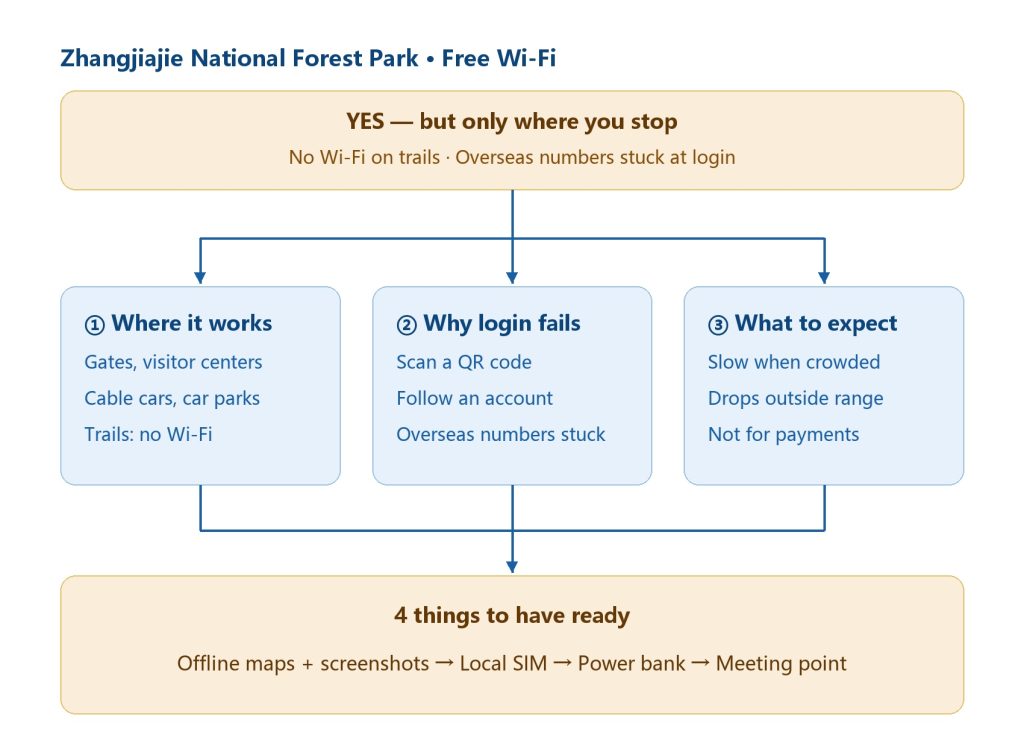
Yes, but only where visitors stop. Ticket gates, visitor centers, the upper and lower stations of cable cars and lifts, restaurants and car parks all have free Wi-Fi. Once you step onto the Golden Whip Stream trail or stand on a viewing platform in Yuanjiajie, there is no Wi-Fi — only mobile signal. Most of these networks need a QR code to log in, and overseas phone numbers often cannot receive the verification code. Think of it as a top-up along the way, not something that covers your whole day.
1、Where you can connect
The park does not cover every corner with Wi-Fi. It is installed where visitors buy tickets, wait for transport and eat. In the order you would travel, the places you can connect are:
The five entrance gates of Zhangjiajie National Forest Park: Forest Park Gate (South), Wulingyuan Landmark Gate (also called Wujiayu Gate, East), Tianzi Mountain Gate (North), Yangjiajie Gate (West) and Zimugang Gate (Central). The ticket halls and entry squares at all five have free Wi-Fi.
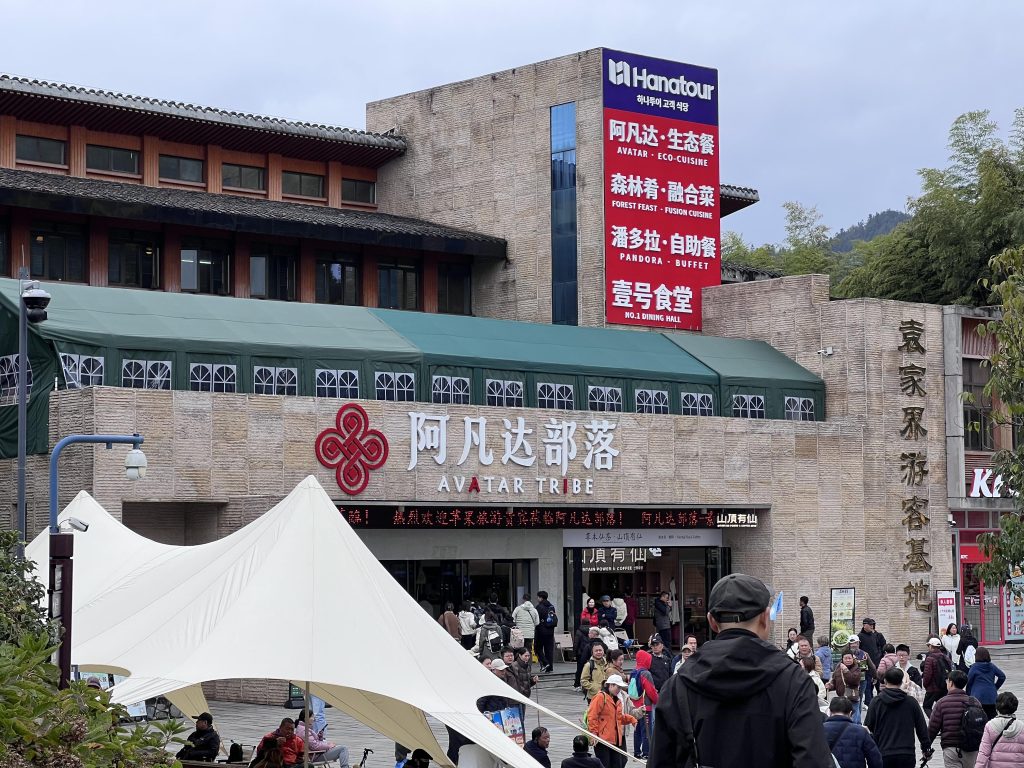
Along the Bailong Elevator: the waiting hall at the lower station, the middle station and the viewing platform at the upper station all have free Wi-Fi. At the top is the Yuanjiajie Visitor Center, where the restaurant, rest hall, café, square and the bus station next door all have free Wi-Fi.
Around Tianzi Mountain: He Long Park, the upper and lower stations of the Tianzi Mountain cable car and the visitor service points along the way all have free Wi-Fi.
Around Yangjiajie: the Yangjiajie cable car station and the Zimugang area have free Wi-Fi.
Ten-Mile Gallery: the mini-train starting station and the route have free Wi-Fi.
Baofeng Lake and Longfeng’an: the lake dock, the waterfall stage and the visitor service area at Baofeng Lake have free Wi-Fi, and so does the boardwalk at Longfeng’an.
Car parks: the car parks at Wulingyuan Landmark Gate, Forest Park Gate and the lower station of the Bailong Elevator all have free Wi-Fi.
Outside the park, free Wi-Fi is available at Zhangjiajie Hehua Airport, Zhangjiajie West Railway Station (high-speed), the railway station, the long-distance bus station and the Tianmen Mountain ticket gate. The city center and towns all have 5G signal.
There is no free Wi-Fi on the walking trails inside Zhangjiajie National Forest Park. The Golden Whip Stream trail from Shuiraosimen to Forest Park Gate, the climb from Wulong Village to Tianbo Mansion and the plank path from Yuanjiajie to the First Bridge Under Heaven have no Wi-Fi.
How to find the free Wi-Fi at these spots: look for a free Wi-Fi sign on the wall or a post, with a QR code you can scan to connect. Some tickets also print a QR code on the back.
For a reliable signal, your accommodation is actually the best bet. Hotels and guesthouses almost all have Wi-Fi, and the Wi-Fi in valley guesthouses is good enough for video calls. Cafés around Xibu Street in Wulingyuan tested at 20 to 50 Mbps; Starbucks drops to about 10 Mbps at peak times and gets crowded and noisy. But valley guesthouse Wi-Fi slows down during check-in hours, and some give you a “false signal” — connected, but no page will open.
2、How to connect, and why it often fails
These networks do not share one name. The operator or sponsor names each spot, so every location has a different one. Around the Bailong Elevator, for example, the network is called “BaiLongSkyLadder” or “百龙天梯”. If you see an open network you don’t recognize in your phone list, it is probably the park’s hotspot.
Seeing the network does not mean you are online. A login page will usually appear: scan a code, follow an official account or open a mini-program, then tap “free internet” to get access. Some spots also ask for a phone number and a verification code.
This is the step where foreign visitors most often get stuck. Overseas phone numbers frequently never receive the code, and if your WeChat is not verified with an ID or linked to a bank card, the authorization will not go through. Right after landing, staff can help: the information desk at Zhangjiajie Hehua Airport can connect you, at +86 744 8238417, open from 05:30 until the last flight of the day. Once you are in the park, there is no such service. If anyone in your group gets online, ask them to turn on a hotspot — much faster than trying over and over yourself.
3、Three things to expect once you are on
Slow. Several hundred people may be connected at once on a viewing platform. Photos load, but streaming video or uploading large files is basically out of the question.
It drops out. The Wi-Fi runs on fiber, so it cuts off when you leave the coverage area, and coming back means logging in again. Logging in several times a day is normal.
Don’t handle anything important on it. On an open network, don’t log in to online banking or enter payment passwords. For tickets and payments, mobile data is safer.
4、Four things more reliable than looking for Wi-Fi
Download offline maps and save your screenshots before you go. While on hotel or ticket-gate Wi-Fi, download offline maps for the forest park and Tianmen Mountain. Save your ticket QR codes, hotel booking and driver’s number to your photo album too — these are even more useless without a connection than a map is.
Get a local SIM card. Up the mountain, it is 4G and 5G that you can rely on, not Wi-Fi. China Mobile holds calls and messages even in the valleys.
Bring a large power bank. When the signal is weak, your phone keeps searching for a network and drains much faster than usual. Shared power bank stations are few inside the park, so don’t count on them.
Agree on a meeting point and time with your group. If you get separated, go back to the nearest ticket gate or cable car station — there is Wi-Fi there and staff you can ask.
The free Wi-Fi in Zhangjiajie National Forest Park is enough for one social post, a few messages and checking when the next shuttle leaves — but it will not keep you online all day. Think of it as a top-up along the way. Have your offline maps, local SIM and battery ready, and you will be fine in the mountains.