
Is eSIM Signal Reliable Inside Zhangjiajie Scenic Areas?
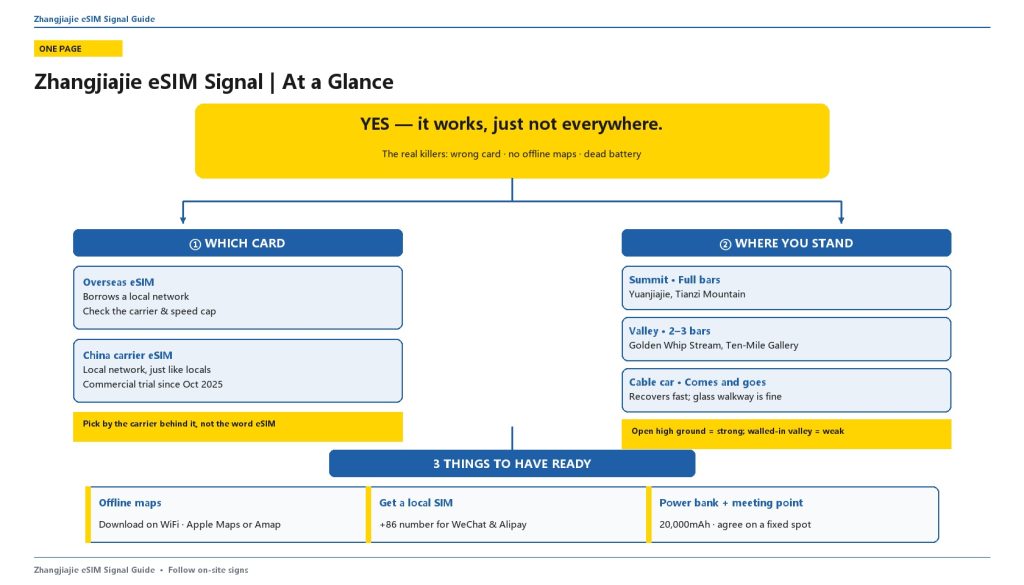
It works, and it is steadier than you would expect. The main routes and viewing platforms in Zhangjiajie National Forest Park and Tianmen Mountain all have signal, and on the summits it is often full bars; in the valleys and on the cable cars it drops to two or three bars — text messages still go through, but photos take a while. What actually leaves you offline is rarely weak signal: it is usually not having offline maps downloaded, a dead battery, or the wrong card.
1、First, check where your card comes from
An eSIM and a physical SIM use exactly the same cell towers — the card itself does not decide how strong the signal is. What decides it is the carrier behind it.
An eSIM bought overseas borrows a Chinese carrier’s network once you arrive, and the speed depends on which carrier it partners with and whether there is a cap. Read the detail page before you buy: if it only says “high-speed data” without naming which network, going into the mountains is a bit of a gamble.
eSIMs from China’s three major carriers were approved for commercial trials in October 2025 and run on the local network, so inside the scenic areas they are no different from the cards locals use. But the service is still being rolled out — whether the airport can issue one and which phones are supported both have to be asked on site. Before you leave, check whether your phone supports that eSIM, so you do not find out at Zhangjiajie that it will not install.
2、Where you actually get signal
The viewing platforms on the summits are the best. Yuanjiajie, Tianzi Mountain, He Long Park, Yubi Peak — 4G and 5G are usually full bars, and sending photos or watching video is smooth.
Valleys and streamsides are weaker. The middle section of Golden Whip Stream and the stretches of Ten-Mile Gallery blocked by the mountain drop to two or three bars. Text messages still go through; large photos have to wait.
Cable cars and the shuttle buses fluctuate, then recover quickly. The tunnel escalators on Tianmen Mountain are relatively weak, while the glass walkway is actually fine.
The carrier matters far more than whether you use an eSIM or a physical card. China Mobile has the widest coverage and the steadiest signal — calls and messages hold even in the valleys. China Unicom is faster and fine on the main routes, but drops to 2G in a few places on the less-travelled walkways. China Telecom sits between the two and often offers 7- to 30-day tourist cards, though some phone models have band issues, so have the counter confirm before you buy.
Put simply: signal is good up high and in the open, and weak at the bottom of a valley walled in by rock.

3、When you lose the network, signal is not the real problem
First, Google Maps does not work in China. The map data is offset and navigation will send you the wrong way. Switch to Apple Maps or Amap; neither needs a VPN and both work straight away. While you are still on hotel or airport WiFi, download the offline maps for the forest park and Tianmen Mountain — they will guide you even where there is no signal.
Second, without a +86 number, WeChat and Alipay will not work properly. Buying water or tickets in the scenic areas often means scanning a code. Registering WeChat on an overseas eSIM or linking a bank card can stall, and linking an overseas card to Alipay works on some cards and not on others. This is not a signal problem — the app simply will not work. Even if you buy an overseas eSIM, it is worth getting a Chinese SIM at the airport as well, just for payments. The Foreign Visitor Service Center at the international arrivals exit can issue one: bring your passport and you will see it the moment you come out.
Third, bring a high-capacity power bank. Where the signal is weak, the phone keeps hunting for a network and drains far faster than usual.
Fourth, agree on a meeting point with the people you are travelling with. If you really do end up at the bottom of a valley with no signal, follow the well-built trails out instead of standing there waiting for bars.
To put it plainly: an eSIM works in Zhangjiajie. The mountains knock it down a notch, but what really decides your experience is having offline maps, payments and battery sorted before you go. When you choose a card, look at which carrier is behind it — that is far more useful than the word “eSIM”.