
How to Fly to Zhangjiajie: Direct Flights and Connecting Routes
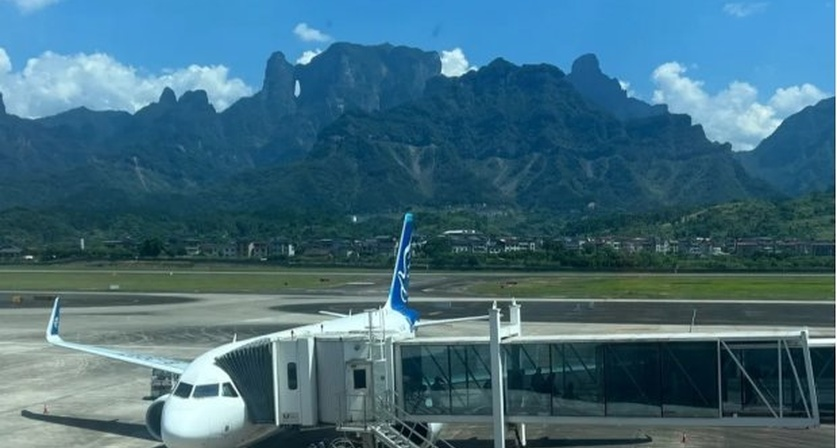
Flight information covers the 2026/27 winter–spring season (25 October 2026 – 28 March 2027)
Zhangjiajie Hehua International Airport is a small airport, and its international routes are almost all in Asia. If you are departing from Europe or North America, there are no nonstop flights—you will need to connect once. Where you connect determines not only the price and total travel time, but also whether you can enter China visa-free. These three things need to be considered together; otherwise, it is easy to end up with a ticket but a visa problem. This article walks through them in that order.
Which international flights fly directly to Zhangjiajie
South Korea is the mainstay of Zhangjiajie’s international routes. Incheon has about two flights a day, operated by Sichuan Airlines, Asiana, Korean Air, and Eastar Jet; Busan, Daegu, and Cheongju also have routes that rotate by day of the week. Southeast Asia is served by three routes—Bangkok Don Mueang, Singapore, and Ho Chi Minh City—operated by Thai AirAsia, Loong Air, and VietJet Air respectively. The table below lists the exact departure and arrival times and operating days of every direct flight this season, for both arrivals and departures. Days are shown as numbers (1 = Monday, 7 = Sunday). All times are local: Korea is one hour ahead of Beijing, Thailand and Vietnam are one hour behind, and Singapore shares Beijing’s time zone.
2026/27 Winter–Spring Direct International Flight Timetable at Zhangjiajie
| Country/Region | Destination airport | Route | Flight no. | Dep. | Arr. | Days |
| South Korea | Daegu TAE | Zhangjiajie → Daegu | 3U6481 | 15:15 | 18:05 | 4, 7 |
| GJ8261 | 13:30 | 17:20 | 4, 7 | |||
| TW682 | 13:55 | 16:40 | 1, 3, 5, 7 | |||
| Daegu → Zhangjiajie | 3U6482 | 19:00 | 22:35 | 4, 7 | ||
| GJ8262 | 18:10 | 20:45 | 4, 7 | |||
| TW681 | 09:15 | 12:55 | 1, 3, 5, 7 | |||
| South Korea | Incheon ICN (Seoul) | Zhangjiajie → Incheon | ZE352 | 14:35 | 18:35 | 2, 5 |
| RS862 | 16:00 | 18:55 | 2, 4, 6 | |||
| 3U6487 | 16:05 | 19:05 | Daily | |||
| KE164 | 23:40 | 02:40+1 | 2, 6 | |||
| Incheon → Zhangjiajie | ZE351 | 11:15 | 13:35 | 2, 5 | ||
| RS861 | 11:20 | 15:00 | 2, 4, 6 | |||
| 3U6488 | 20:05 | 23:15 | Daily | |||
| KE163 | 18:15 | 22:20 | 2, 6 | |||
| South Korea | Busan PUS (Gimhae) | Zhangjiajie → Busan | BX786 | 13:10 | 16:00 | See note |
| 7C8254 | 14:50 | 17:30 | See note | |||
| Busan → Zhangjiajie | BX785 | 08:30 | 12:10 | See note | ||
| 7C8253 | 10:00 | 13:50 | See note | |||
| South Korea | Cheongju CJJ | Zhangjiajie → Cheongju | 3U6483 | 12:25 | 15:25 | 6 |
| 3U6483 | 13:50 | 16:50 | 2 | |||
| GJ8591 | 12:00 | 16:15 | 3, 6 | |||
| Cheongju → Zhangjiajie | 3U6484 | 19:00 | 22:35 | 6 | ||
| GJ8592 | 17:10 | 19:35 | 3, 6 | |||
| Thailand | Bangkok DMK | Zhangjiajie → Bangkok | VZ3695 | 21:20 | 23:50 | 2, 4, 6 |
| Bangkok → Zhangjiajie | VZ3694 | 17:00 | 20:20 | 2, 4, 6 | ||
| Singapore | Singapore SIN | Zhangjiajie → Singapore | GJ8998 | 10:10 | 15:10 | 2, 4, 6 |
| Singapore → Zhangjiajie | GJ8997 | 16:10 | 21:05 | 2, 4, 6 | ||
| Vietnam | Ho Chi Minh City SGN | Zhangjiajie → Ho Chi Minh City | VJ5023 | 21:15 | 00:05+1 | Charter, see note |
| Ho Chi Minh City → Zhangjiajie | VJ5022 | 16:50 | 20:15 | Charter, see note |
Note: The Busan routes operate on a segmented schedule, and the Ho Chi Minh City route is a charter service flying only on specified dates—confirm exact dates with the airline. “02:40+1” and “00:05+1” in the table mean arrival on the following day.
There are no scheduled nonstop flights to Zhangjiajie from Europe, North America, Japan, Australia, or Hong Kong—none in either the summer–autumn or winter–spring season. All of these origins require at least one connection. Be careful with “direct” results on third-party booking sites: they are usually connecting itineraries with a stop, not true nonstop flights. Schedules change frequently, so confirm operating days and times with the airline or airport before ticketing. The airport information line is +86 744 2233666.
Where to connect when flying from Europe or North America
Since a connection is unavoidable, the key question is where to connect. The second leg—from the connecting city to Zhangjiajie—determines total travel time and cost. The seven main connecting cities are compared below.
Comparison of seven connecting cities (second leg to Zhangjiajie)
| Connecting city | Long-haul flights from Europe/US | Second leg to Zhangjiajie | Time | 240-hour visa-free port |
| Shanghai (best overall) | Very dense; the widest choice of international long-haul flights in China | Direct, 3–4 flights daily | About 2.5 hours | Yes (Pudong / Hongqiao) |
| Guangzhou (shortest second flight) | China Southern hub; nonstop from London, Paris, Frankfurt, and Los Angeles | Direct CZ3381, once daily (about 1 hr 45 min) | About 1 hr 45 min | Yes (Baiyun Airport) |
| Seoul (smoothest transfer) | Incheon is dense; Korea itself visa-free for most European/US passports | Direct, about 2 flights daily | About 3 hours | Can apply on arrival at Zhangjiajie |
| Beijing | Dense, with many European/US routes | Direct, 2–3 flights daily (CA1953, CA9603, CA8609, etc.) | About 2.5 hours | Yes (Capital / Daxing) |
| Changsha | Almost none; only one weekly flight from London with a high cancellation rate | Maglev + high-speed rail, about 40 trains daily | About 3.5 hours | Yes (Huanghua Airport) |
| Chongqing | Few European routes; essentially none from North America | Direct high-speed rail, 4–5 trains daily | 3.5–4.8 hours | Yes (Jiangbei Airport) |
| Hong Kong | Dense long-haul network | High-speed rail G6080, once daily (08:07–14:49); no nonstop in winter | 6 hr 42 min | West Kowloon counts as a port, but the routing is easy to get wrong |
Guangzhou deserves a special mention: it is a China Southern hub with far more European/US long-haul options than Changsha, including nonstops from London, Paris, Frankfurt, and Los Angeles. The flight from Guangzhou to Zhangjiajie takes just one hour and 45 minutes—the shortest second leg of any connecting city. However, there is only one flight a day (CZ3381), departure times vary by weekday, and fares range from ¥530 to ¥910, making connections less flexible than in Shanghai. By rail, there are about nine direct trains a day from Guangzhou South to Zhangjiajie West, the fastest taking 5 hours 41 minutes—much slower than the Changsha route.
In short: for the fastest trip, fly to Shanghai or Seoul and then take a direct flight to Zhangjiajie; for the best overall value, choose Shanghai; if you want plenty of European/US nonstops and a short second leg, consider Guangzhou; and if you are already in China and just want to save money, consider the high-speed rail from Changsha.
How flight routes and visa-free rules fit together
Your connecting city is not just a price question—it determines whether you can enter China visa-free, so the route should be chosen according to your passport.
The first case is a passport on the 30-day unilateral visa-free list of 50 countries, including the UK, Canada, Australia, New Zealand, Japan, South Korea, most European countries, and Brazil. This is the easiest situation: a normal round-trip ticket is enough, you can enter and exit at any port, no third-country ticket is required, and you simply pick Shanghai or Seoul based on time and price.
The second case is a passport not on the 50-country list but on the 57-country list—most typically a US passport. These travelers must use the 240-hour transit visa-free policy, which requires an itinerary of “Point A → China → Point B,” with the place before entering China and the place after leaving China being different. A simple “Europe/US ⇄ China” round-trip does not count as transit and cannot be used. There are two clean options: via Seoul, the route is US → Seoul → Zhangjiajie (where you enter China) → Bangkok or Singapore → home. The country before China is South Korea and the one after is Thailand or Singapore—different places, so you qualify—and Seoul, Bangkok, and Singapore all have direct flights to Zhangjiajie. Via Shanghai, the route is US → Shanghai (enter China) → Zhangjiajie → Seoul or Bangkok → home. Shanghai entry and Zhangjiajie exit are both designated ports, and travel from Shanghai to Hunan is interprovincial, which is permitted.
It is worth explaining why Seoul works especially well for US passports: the policy being used here is the 240-hour transit visa-free scheme. Korea visa-free entry policies let most European/US passport holders wait in Seoul and connect to Zhangjiajie without difficulty, and Korea has the densest direct flights to Zhangjiajie—Incheon, Busan, Daegu, and Cheongju together offer far more services than any other international origin. Entering through Seoul makes Korea your “Point A”; adding an outbound ticket to Bangkok or Singapore creates a clean “Point A → China → Point B” itinerary, solving the visa-free rule and the transfer problem at once. By contrast, passports from the 50-country list, such as the UK, Canada, and Australia, already enjoy 30-day visa-free entry,so an ordinary round-trip like “London → Seoul → Zhangjiajie → Seoul → London” is perfectly fine and does not require a third destination. Note that “Korea visa-free” here refers to Korea’s own entry policy, not China’s 30-day visa-free scheme—do not confuse the two.
Booking separate tickets and flying different airlines are both fine, but keep your confirmed onward ticket and print a copy, as both the airline and border control will check it. If you need to stay longer or travel outside the permitted area for urgent or legitimate reasons, apply in advance to the local exit-entry administration of the public security authorities for a stay permit. The third case is a passport on neither list: you must obtain a Chinese visa before departure, and no flight routing can get around this.
One final reminder: of the 50 countries on the 30-day unilateral visa-free list, Brunei’s waiver has no expiry date, Russia’s has been extended to 31 December 2027, and the remaining 48 countries’ policies currently run until 31 December 2026. Check the latest information with your airline and Chinese embassies or consulates before buying tickets.
Sources and disclaimer
Flight information is based on Zhangjiajie Hehua International Airport’s published 2026/27 winter–spring timetable (25 October 2026 – 28 March 2027) and current schedules. Visa information reflects National Immigration Administration policies as of November 2026; the 30-day unilateral visa-free policy for most countries is scheduled to expire on 31 December 2026, except for Brunei and Russia. Schedules and visa policies may change—always confirm with airlines, the airport, and Chinese embassies or consulates before ticketing and travel. This article is general information and does not constitute legal or travel advice.